
Chroma - The Most Complex Characteristic Of Color
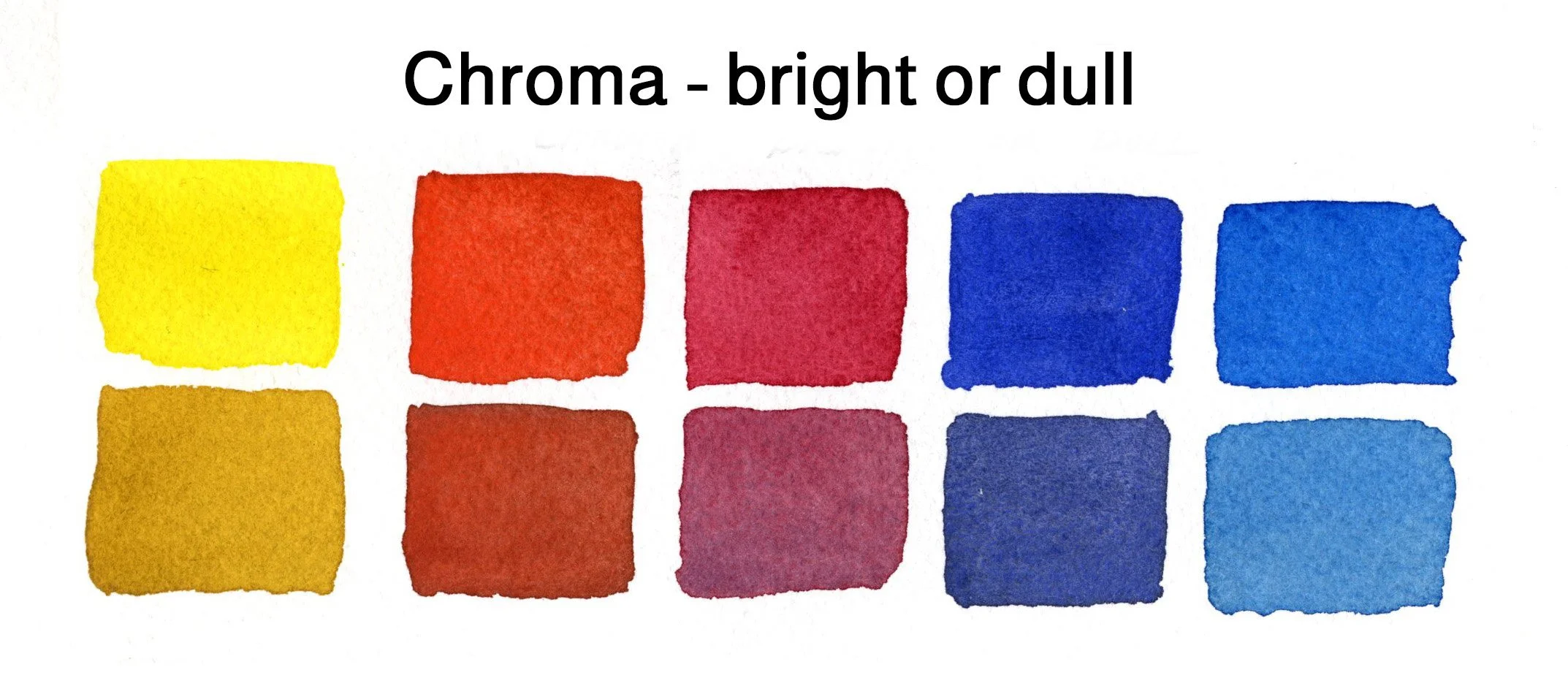
Chroma is the most difficult Characteristic of Color to understand. First of all, it’s a bit of an unusual word so its meaning may not be clear. Intensity and Saturation are two more familiar words that are often used as substitutes. Neither is exactly equal to Chroma which is really a measure of absolute color strength compared to white.
The best way to think of Chroma is as a representation of the "purity" of a color - high chroma color is more pure, lower chroma color less pure.
Intensity, Saturation And Chroma
For some colors – principally yellows, oranges and reds – The point of highest Chroma is also the point of highest intensity and highest saturation. When squeezed from the tube onto the palette the these bright colors are all pigment with some gum arabic, but no water. In this condition, the color is fully saturated; it is also at highest Chroma, and one could say it is at its highest intensity.
For many others – some violets, many blues and some greens, it is not the case. Right out of the tube and at maximum saturation, these colors can appear very dark, so much so it can be difficult to identify the actual hue. For these darker colors, the highest Chroma and Intensity occur when the color is lightened – or somewhat de-saturated.
Perhaps the best way to think about Chroma, especially highest Chroma, is to use two non-painting metaphors: The highest Chroma occurs when it is “singing loudest” or “burning brightest”.
Bright And Dull
The great news is that you will rarely need any color to be at highest Chroma in your painting. Since we are most concerned with color relationships within the context of a picture plane, thinking about Chroma as a relative measure of bright vs dull is sufficient for most subjects and scenes.
As with value and temperature, our perception of “Bright” or “Dull” for a particular color will influenced by the relative “Bright” or “Dull” of the other colors in the picture plane.
Changing Chroma
Watercolor paint is at highest saturation right out of the tube or dry, in the wells on the palette, As you know, some colors will also be at highest Chroma in this state, while others will not. In either case, there are two ways to change the Chroma – or apparent Brightness – of a color.
The first is to simply dilute the color with water. Water is the medium for watercolor and is necessary to get the paint from palette to paper. It is also our “white” since the addition of water lightens and lowers the color intensity or chroma of the color – just like adding white to any color in an opaque medium. This method changes the Value and Chroma of the color, but not the Hue or Temperature.
The second is to mix the color with another. This is especially true when mixing a color with its Complement. In this case, the Hue, Chroma and Temperature will all be changed. Value may also be changed.