
Hue
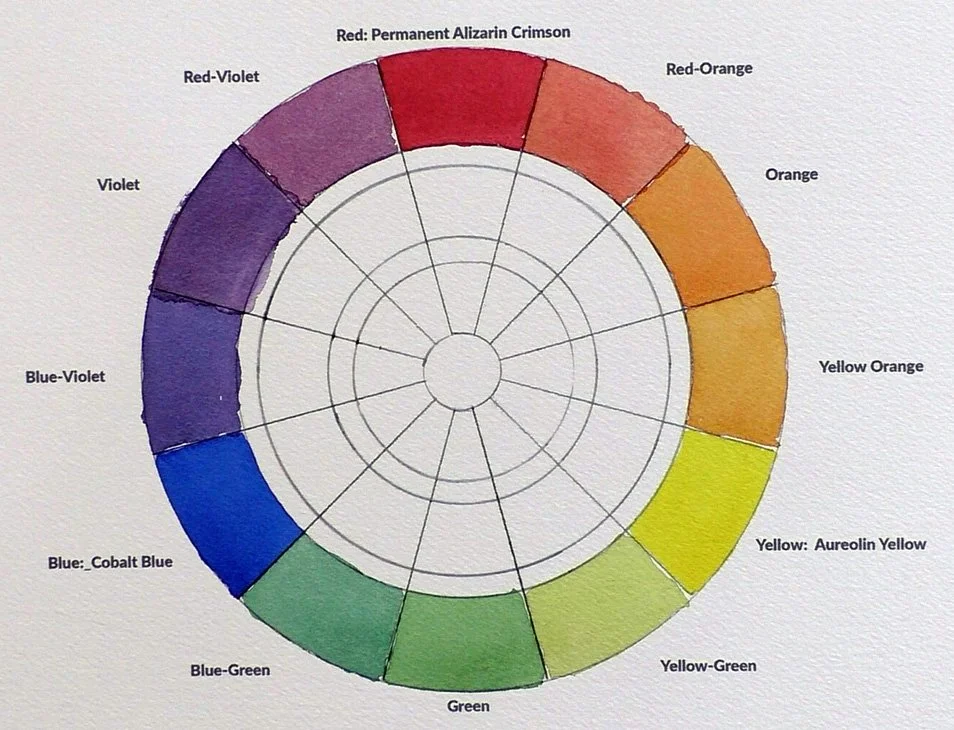
Of the four characteristics of color, Hue is the most easily understood.
Usually, the hue is a general name that really describes a range of color in essentially the same hue. It can be described as a family of color with a range of hues that vary but still would be identified by a single word.. Both lemons and the petals of a sunflower are yellow, but they are clearly not exactly the same color.
We mostly think of color very simply and single-dimensionally. This works fine in most aspects of our life. But, the artist really needs to understand all aspects of color.
Color Complexity
As mentioned, color is a term that is often used in a way that encompasses its separate characteristics very general way. Usually, when referring to color we are describing what is known as its hue and mostly use it to refer to its general local color.
The color of any object will likely look different in different qualities of light, but we are likely to still think of the color, or hue, in very simple terms, even though the apparent color has changed.
In short, hue is just one of three important aspects of color to understand. The others are Value and Chroma.
Hue is best understood and used in a painting in its relationship to the other hues included in the painting.
Color Families
Hue families are, as mentioned, a way of categorizing various hues into one of twelve color families. These families are the ones identified by Sir Issac Newton when he directed light through a prism, separating white light into a 'spectrum' of color. Each separate wavelength represented a portion of the total range of visible light. This same spectrum is visible in rainbows.
Those identifiable hues became the basis for establishing a logical system for organizing hues and their relationships to one another. In all there are twelve color families, the names of which will be familiar because they are the same as those used in basic color theory when describing Primary, Secondary, and Tertiary Colors.
There are three Primary Colors - Red, Yellow and Blue. They are called primary colors because they are not 'mixable' by combining two other colors.
There are three Secondary Colors - Orange, Green, and Violet. Secondary colors are those that are created by more or less even mixtures of two primaries together : red & yellow for orange; yellow & blue for green; blue & red for violet.
There are six Tertiary Colors. Think of them as un-equal mixtures of two primaries or the combination of a Primary and a Secondary. They are given hyphenated names that includes the name of one Primary Color and one Secondary color like “blue-violet”, “blue-green”, or “red-orange”.
The Color Wheel
This color wheel is a very useful tool that helps simplify the complex topic of color. They are 'wheels'. The wheel is formed by taking Newton's light spectrum and form a cylinder by touching red to violet.
The result is a circle with a hue representing each color family on the outside ring.

Color Wheel With Twelve Hues Corresponding To Each Of The Color Families
A simple color wheel like this is a starting point for simplifying the complexity of color by organizing hues by family and clearly representing various color relationships.